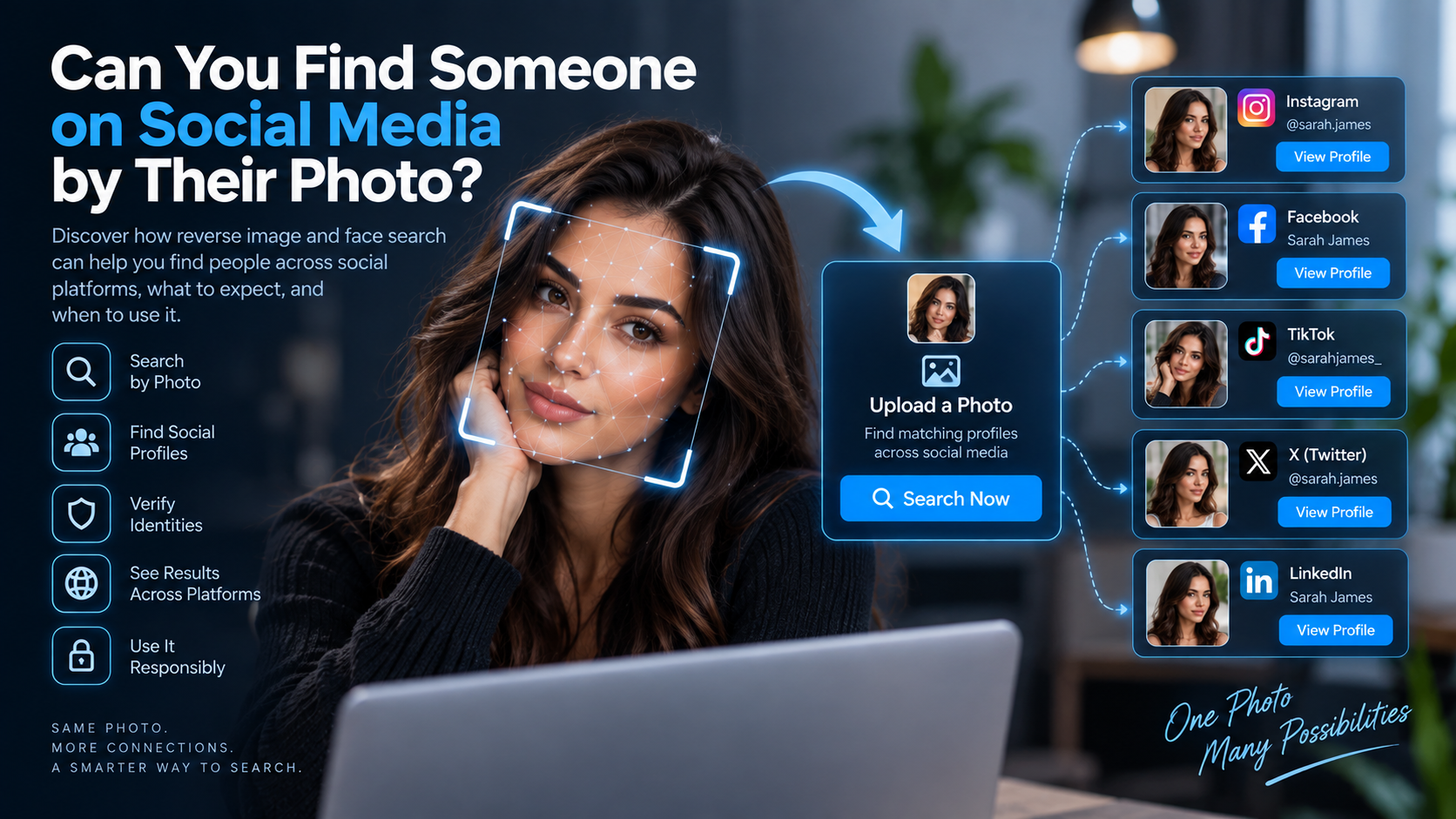
Sometimes, and increasingly often, but not reliably. Since mid-2025, Google has indexed public posts from Instagram's business and creator accounts, which means a reverse image search can now surface a social profile it couldn't have found two years ago. Private accounts and personal profiles are a different story entirely, and knowing which category you're dealing with matters more than which tool you pick.
Why the Honest Answer Is "It Depends on the Account"
The single biggest factor isn't the photo, the tool, or the platform. It's what kind of account the photo lives on.
Account Type
- Public business/creator (Instagram, since 2025)
- Public personal account
- Private account
Indexed by Google?
- Yes
- Rarely, inconsistently
- No
Findable by Reverse Search?
- Yes, often
- Occasionally, via third-party crawling
- Effectively never
What's Visible If Found
- Public posts, captions, alt text
- Whatever the platform allows publicly
- Nothing beyond the profile photo itself, if that's even public
What Actually Changed in 2025
For most of the last decade, the honest answer to this question was closer to "rarely." Instagram and Facebook both used robots.txt files and noindex tags specifically to keep search engines out, treating their content as a walled garden rather than part of the open web.
That shifted on July 10, 2025, when Instagram began allowing Google and Bing to index public content, posts, Reels, and carousels from business and creator accounts, retroactively covering content posted from 2020 onward [Verify: confirm current 2026 rollout coverage by region, as the expansion has continued gradually]. Personal accounts, private accounts, Stories, and accounts belonging to users under 18 remain excluded by design.
This is a genuine shift, not a minor tweak. A photo tied to a public business or creator account today has a real chance of surfacing through a standard reverse image search, something that would have failed outright in 2023. Most competitor advice on this topic hasn't caught up to the change yet.
The mechanism matters for understanding why some accounts show up, and others don't. Google isn't running facial recognition against Instagram's entire library; it's simply been allowed, for the first time, to crawl and index the public post itself: the image file, the caption, the alt text, any geo tags attached. A reverse image search finding a match isn't Google "recognizing" a face; it's the underlying image file existing in a page Google was finally permitted to catalog. That distinction explains why an unindexed personal account with the exact same photo produces nothing: the image simply doesn't exist anywhere Google is allowed to look.
Public accounts that write descriptive captions and use alt text unintentionally make their own photos easier to find this way. A caption mentioning a real name, a location, or a business name gives a search engine far more to index than the image alone, and that surrounding text often ends up mattering more than the picture itself. A business account optimizing for discovery is, by definition, making itself more searchable by photo as a side effect.
Platform by Platform: What's Actually Searchable
Instagram. Public business and creator accounts, indexed since 2025, as covered above. Personal accounts remain largely outside Google's index. Instagram itself has no built-in reverse image search feature, so any search still routes through an external tool.
Facebook. Historically more restrictive than Instagram, though public Pages (business and organization accounts, distinct from personal profiles) have long had some indexed presence. Personal Facebook profiles are essentially unsearchable by photo unless a specific image has been shared publicly and picked up elsewhere.
LinkedIn. Public profiles are generally indexable, and a professional headshot is one of the easier photo types to trace back for exactly that reason: consistent lighting, a single canonical source, and a platform that doesn't restrict crawling the way Instagram historically did. Company pages follow similar logic; most of what's publicly listed gets crawled eventually.
TikTok and X (formerly Twitter). Coverage varies and changes often enough that a specific claim here would go stale quickly [Verify: current indexing status for TikTok and X profile content as of your publish date]. Treat both as inconsistent rather than reliable.
Regional and Legal Variation Adds Another Layer
Indexing policy is only half the picture. Data protection law, GDPR in the EU and similar frameworks elsewhere, shapes how aggressively platforms are willing to expose public content to search engines in the first place, which is part of why global rollouts like Instagram's 2025 change happen gradually by region rather than everywhere at once. A search that works cleanly in one country can behave differently in another, not because the technology changed, but because the legal environment around it did.
When It Won't Work, Even on a Public Account
AI-generated or synthetic profile photos. A reverse search needs an original source to trace back to. A synthetic image generated specifically for the profile has no such source, so even a fully public account with a clear, high-quality photo can return nothing.
Heavily filtered or edited photos. The same logic that affects face-matching accuracy elsewhere applies here: a filter that reshapes facial features can push a photo below the similarity threshold, even against its own original source.
Group photos used as a profile picture. The system has to guess which face in the frame is the account owner, and it guesses wrong often enough that this is one of the most common reasons a search returns nothing useful.
Brand-new accounts. Indexing takes time. A profile created days or weeks ago, even a fully public one, may simply not have been crawled yet.
Accounts based in regions with staggered rollout. The 2025 policy expanded gradually by region rather than everywhere at once [Verify: confirm current regional coverage]. An account that's technically eligible under the policy may still not be indexed depending on where it's based.
The Search Process, Step by Step
- Start with the highest-quality version of the photo you have. A screenshot of a screenshot loses detail with every save.
- Crop to just the face or the primary subject, removing captions, borders, or other people in frame.
- Run a general reverse image search first, since it's the faster check and covers exact-match and similar-image results in one pass.
- If the goal is confirming a specific person rather than just finding a similar picture, follow up with a face-matching tool. The difference between these two searches is explained in full here.
- Check any source links that come back. A result pointing to an indexed public post is a real lead; a loosely similar stock photo is not.
- Cross-check with a second photo if one exists. A single match is a lead; the same account surfacing from two independent photos is a much stronger signal.
What a Successful Search Actually Looks Like
A profile picture from a small business's Instagram account- a florist, a personal trainer, a boutique- is often the easiest realistic case. The account is public and professional by nature; the photos are likely indexed under the 2025 policy, and a reverse search frequently surfaces the business's own posts directly, sometimes with the person's name in a caption or bio screenshot picked up along the way.
A mid-sized creator account sits somewhere between the extremes. The account is public and likely indexed, but creators often post many similar photos, event coverage, promotional shots, casual updates, which can produce a cluttered results page rather than one clean match. In that case, the useful signal isn't the first result; it's the pattern across several results pointing back to the same account.
Compare both to a personal photo shared only within a private friend group. Even with a clear, high-quality image, there's often nothing to find, not because the search failed, but because the content was never public in the first place. The absence of a result here isn't a dead end; it's the platform's privacy setting working as intended.
The Responsible Way to Actually Do This
Finding a social account from a photo is a normal thing to want to do: checking a dating match, confirming a seller, reconnecting with someone. It stops being reasonable the moment the goal shifts to monitoring someone who hasn't given you a reason to, or using what you find to contact them uninvited. Where that line sits is worth reading in full before running a search that involves someone else's photo.
For the face-matching step specifically, CheckFace’s reverse image search tool runs the comparison directly and doesn't retain your uploaded photo after the search completes.
Frequently Asked Questions
Will someone know if I find their social media from a photo?
No. Neither the search tools nor the platforms notify a user when their public content is found through a reverse image search.
Does this work for private Instagram or Facebook accounts?
No, effectively never. Private accounts aren't indexed by search engines, and a reverse image search has nothing to crawl.
Why did my search find nothing even though I know the person is on social media?
Most likely, the account is personal rather than business/creator, the photo is heavily filtered or AI-generated, or the account is too new to have been indexed yet. A full breakdown of causes and fixes applies here too.
Is finding someone's social media from a photo the same as a background check?
No. It only surfaces public content already indexed online. It doesn't confirm identity, pull records, or verify anything beyond what's already publicly visible.
Can I do this from my phone, or do I need a computer?
Either works. The Android-specific routes and the Mac and desktop methods both cover mobile and desktop approaches in detail.
Does a profile picture get treated differently than other posted photos?
Somewhat. A profile picture is usually the most-viewed image on an account but isn't always the most indexed one; a tagged post with a caption often carries more of the searchable context than the profile photo alone.
Does this work the same way for Facebook as it does for Instagram?
Not exactly. Facebook's indexing has historically been narrower and more inconsistent than Instagram's post-2025 policy, and there's no equivalent public announcement extending the same retroactive coverage to Facebook. Treat Facebook results as less predictable.
If I make my account private, does that remove photos already indexed?
Not immediately, and not always completely. Search engines cache pages, so a photo indexed while an account was public can remain visible in search results for a period after switching to private, even though the live account itself is no longer accessible.