How Facial Recognition Has Improved in the Last 5 Years
Facial recognition has changed considerably over the past several years.
The biggest improvement isn't that computers suddenly became capable of "seeing" faces. Face detection and recognition existed long before today's AI systems.
The important change is how modern systems represent faces, handle variation, retrieve candidates at scale, and evaluate their own errors.
A photograph taken today can look very different from another photograph of the same person. The camera may be different. The lighting may change. The person may turn their head, wear glasses, grow facial hair, or simply appear several years older.
Modern recognition systems are designed to deal with many of these variations more effectively than earlier approaches.
But that doesn't mean facial recognition is infallible.
From Hand-Designed Features to Learned Representations
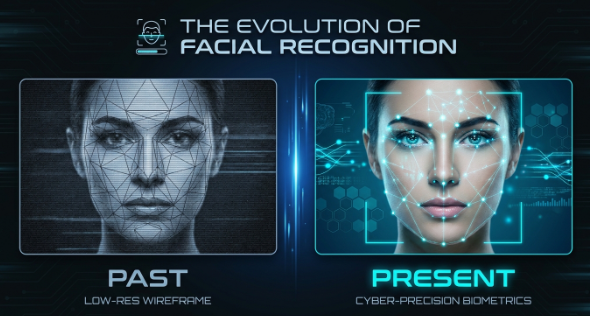
Earlier computer-vision systems often depended heavily on manually designed visual features.
Developers could measure relationships between facial landmarks, edges, textures, and other characteristics. These approaches were useful, but they struggled when photographs moved far away from controlled conditions.
Deep learning changed the way many modern systems approach the problem.
Instead of relying entirely on hand-designed rules, neural networks can learn visual representations from large datasets.
A recognition model can process an image and produce a numerical representation known as an embedding.
Rather than storing a face as a collection of simple measurements, the embedding captures learned characteristics that can be compared with other facial representations.
This doesn't mean the vector is a perfect mathematical identity card.
The representation can still be affected by image quality, pose, lighting, age, occlusion, and other factors.
The advantage is that modern models can learn patterns that are considerably more flexible than simple pixel or landmark comparisons.
Why Embeddings Changed Facial Matching
Consider two photographs of the same person.
One is a professional headshot.
The other is a low-resolution photograph taken outdoors several years later.
A pixel-by-pixel comparison would be almost useless because the photographs are fundamentally different files.
An embedding-based system instead attempts to represent facial characteristics in a form that can be compared mathematically.
If the model has learned representations that are sufficiently robust, the two images can remain relatively close in the model's feature space even though the photographs themselves look different.
That is one of the key ideas behind modern face matching.
Research architectures and loss functions such as ArcFace have helped advance discriminative face representations by encouraging embeddings of the same identity to become more compact while separating different identities.
The practical result is not "perfect recognition." It is a better representation of identity-related visual information.
Pose, Lighting, and Occlusion
Real-world photographs are messy.
A person may look directly at the camera in one image and turn sideways in another.
Lighting can change dramatically between photographs. Shadows can hide parts of the face. Glasses, hats, masks, hair, or other objects can obscure features.
Modern models are generally more robust to these variations than many older systems, but difficult conditions can still cause errors.
NIST's ongoing Face Recognition Technology Evaluation specifically tracks false-positive and false-negative performance and notes that false negatives are strongly influenced by image quality.
This is an important point because facial recognition performance should never be discussed as a single universal accuracy number.
A model can perform extremely well on clear frontal photographs and behave differently on difficult real-world images.
The Mask Era Exposed a Real Challenge
The widespread use of face masks created an unusually large real-world test of facial recognition.
When much of the lower face was covered, systems had less information available.
This encouraged researchers and developers to improve recognition under partial occlusion and to make better use of the visible regions around the eyes and upper face.
But it would be misleading to say that modern algorithms can reliably recognize anyone from a tiny fraction of their face.
Performance depends on the algorithm and the quality of the remaining information.
The broader lesson is more useful:
Modern systems have become better at extracting useful identity-related information when some of the face is unavailable.
That is a much more defensible description of the improvement.
Better Search at Larger Scale
Recognition isn't only about generating an embedding.
A large-scale search system may have millions or more stored representations to compare against.
Comparing a query with every single stored vector becomes increasingly expensive as the collection grows.
This is where approximate nearest-neighbor search becomes useful.
Structures such as HNSW allow systems to retrieve vectors that are close to a query without performing a full exhaustive comparison against every item.
The result can be dramatically faster retrieval while maintaining a useful level of search quality.
The exact performance depends on the implementation, hardware, index structure, and search parameters.
So claims that a particular system can search "billions of faces in milliseconds" should always be treated cautiously unless the architecture and benchmark are clearly documented.
The underlying technology, however, is real and important: efficient vector retrieval is one of the foundations of large-scale visual search.
Better Evaluation, Not Just Better Models
Another important improvement is the way facial-recognition systems are evaluated.
It is not enough to say that an algorithm is "99% accurate."
Accuracy depends on the dataset, threshold, task, image quality, and population being tested.
NIST distinguishes between one-to-one verification, where two images are compared to determine whether they represent the same person, and one-to-many identification, where a query is searched against a database.
Those are different problems and need different measurements.
NIST's current evaluations report false-match and false-non-match behavior and examine demographic differences as part of ongoing testing.
This kind of evaluation is important because it shows where an algorithm works well and where additional caution may be necessary.
False Positives Still Matter
Improved facial recognition has not eliminated errors.
A false positive happens when a system incorrectly associates two different people.
A false negative happens when the system fails to associate two photographs that actually belong to the same person.
Both can matter, but the consequences depend heavily on the application.
NIST's evaluations show that error rates can vary between algorithms and across demographic and image conditions.
This is why responsible facial search should never reduce a complex matching problem to a single similarity score.
A score is evidence generated by a model.
It is not a substitute for context.
What Has Actually Improved?
Looking at the last five years, several developments stand out.
Better learned representations
Deep neural networks have made facial embeddings more expressive and useful for matching.
Greater robustness
Modern systems are generally better at handling variations in pose, lighting, expression, image quality, and partial occlusion.
Faster retrieval
Vector-search infrastructure allows large collections of embeddings to be searched efficiently.
Better evaluation
Benchmarking has become more sophisticated, with greater attention to different tasks, error types, demographic effects, and operating thresholds.
More practical applications
Facial analysis is no longer limited to specialized research environments. Computer vision is increasingly available through consumer products, APIs, visual-search tools, and other everyday applications.
What Hasn't Changed
One thing is worth emphasizing: better technology doesn't remove the need for judgment.
A model can be highly capable and still make mistakes.
A photograph can contain too little information. A match can be ambiguous. An image can be old, altered, compressed, or misleading.
The consequences of an incorrect match can also vary enormously.
Finding two visually similar photographs in a research context is very different from using a facial match as the basis for a high-stakes decision.
That distinction should influence how results are interpreted.
What This Means for Face Search
These advances make modern face search considerably more practical.
A specialized service such as CheckFaces.ai can use face-focused visual matching to help users investigate whether photographs containing similar facial characteristics appear elsewhere across publicly accessible online sources.
The important word is investigate.
A search result can help uncover a lead, identify related photographs, or reveal that an image has appeared in another context.
It shouldn't automatically be presented as proof of a person's identity.
The Next Stage of Facial AI
The next major improvements are unlikely to come from one breakthrough alone.
Progress will probably continue across several areas at once: stronger visual representations, better handling of difficult images, more efficient retrieval, improved evaluation, privacy-preserving infrastructure, and better ways of communicating uncertainty.
Multimodal AI may also connect facial and visual information with text, metadata, and broader image context.
That could make visual research more useful, but it also increases the importance of responsible design.
Final Thoughts
Facial recognition has improved substantially, but the story isn't simply about algorithms becoming "more accurate."
The technology has evolved from relatively rigid visual measurements toward learned representations that can capture complex facial characteristics. Retrieval systems have become better suited to large-scale searches, while evaluation has become more sophisticated.
At the same time, difficult photographs, demographic differences, thresholds, and false matches remain real considerations.
The most useful way to think about modern facial recognition is therefore not as a perfect identification machine.
It is a powerful pattern-matching technology that has become considerably more capable—and one that still needs appropriate testing, context, and human judgment.