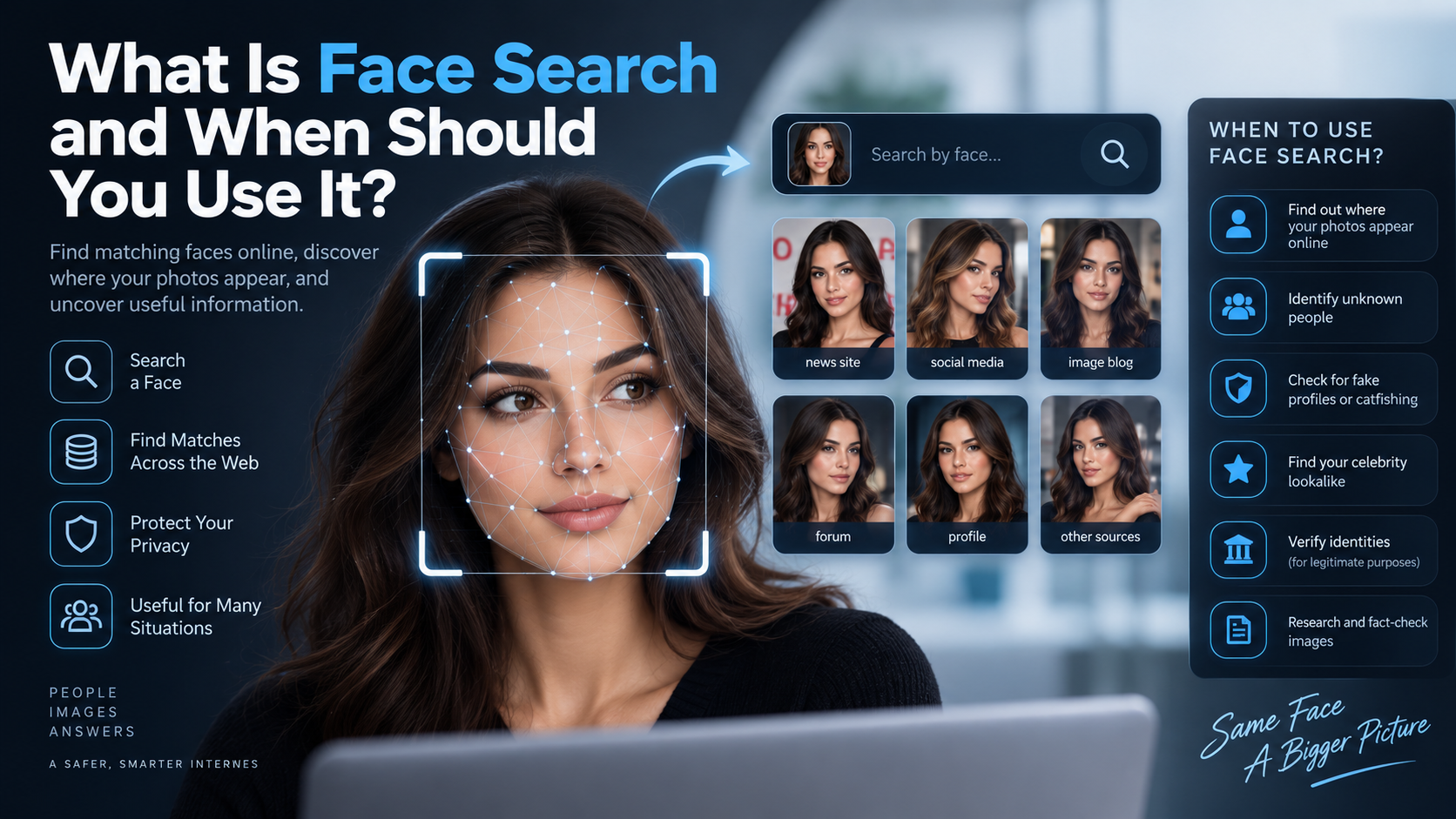
Face search is a type of image-matching technology that compares the geometry of a face, not just the pixels of a photo, against other faces to find visual matches. It's a different mechanism than a standard reverse image search, and knowing which one you actually need is usually the difference between a useful result and twenty wasted minutes.
Face Search vs. Reverse Image Search: The Difference That Actually Matters
People use these two terms interchangeably, and that's where most failed searches start. A reverse image search looks for a picture: the same file, a cropped version of it, or something visually similar in color and composition. A face search looks for a person: it measures the structure of a face, eye spacing, jawline, cheekbone position, nose shape, and looks for that same structure in a completely different photograph.
The distinction sounds academic until you actually need one and use the other. Upload a stolen product photo to a face search tool, and it has nothing to measure. Upload a headshot to a general reverse image tool hoping to find other photos of that same person, and you'll mostly get visually similar strangers, because pixel-similarity and facial-structure-similarity are not the same signal.
Search Type
What It Actually Matches
Best Tool Category
Fails When
Same file or visually similar image
Google Lens, TinEye, Bing Visual Search
The face is real,l but the exact photo has never appeared elsewhere
Facial geometry across different photos
Purpose-built face-matching tools
The photo is heavily filtered, obscured, or at a steep angle
Simple visual similarity
Color, composition, general shape
Yandex Images, Pinterest Lens
You need a specific match, not "things that look kind of similar"
How Face Search Actually Works Under the Hood
The process runs in three stages, and understanding them explains most of the tool's real limitations.
Detection. The system first finds a face in the image and separates it from background, hair, and clothing. A face turned away from the camera, partially covered, or too small in the frame can fail at this stage before any matching even begins.
Feature mapping. The AI plots dozens of measurement points across the face: the distance between the eyes, the angle of the jaw, the width of the nose bridge, the position of the cheekbones. These points get converted into a numerical representation, often called a facial embedding or feature vector, that describes the face mathematically rather than visually.
Comparison. That numerical representation gets checked against a database of other faces, each reduced to the same kind of measurement, and the system returns whichever ones are mathematically closest, usually with a similarity or confidence score attached.
The size and quality of that comparison database matters as much as the matching algorithm itself. A tool checking against a few thousand curated images behaves very differently from one checking against a web-scale index, faster and narrower versus slower and broader, with real trade-offs either way. A narrow, curated database returns fewer false positives but can miss a legitimate match simply because it was never indexed in the first place. A broad, web-scale database catches more ground but needs a higher confidence threshold to avoid drowning genuine matches in noise.
None of this involves the system "recognizing" a face the way a person does. It's geometry, run at scale, against whatever database the tool has access to.
Common Misconceptions About Face Search
"It can identify anyone from any photo." It can't, and reputable tools are explicit about this. Face search returns visual matches based on measured geometry; it doesn't cross-reference names, addresses, or personal records. A tool that claims to hand you a verified identity from a photo alone is overstating what the underlying technology actually does.
"More megapixels means a better match." Resolution helps up to a point, then stops mattering much. A sharp, well-lit, front-facing phone photo at a modest resolution will usually outperform a high-megapixel photo taken at a dramatic angle or in poor lighting, because the system needs a clear view of the measurement points, not raw pixel count.
"If it finds nothing, the person isn't online anywhere." A null result means the specific photo, or a close match, doesn't exist in whatever index that particular tool searches. It says nothing about the person's broader online presence, especially on platforms that actively restrict search-engine crawling.
"Face search and CCTV-style facial recognition are the same thing." They share the underlying math, but consumer face search compares a photo against public image indexes; surveillance-grade facial recognition operates on live video feeds against closed government or private databases. Conflating the two overstates what a consumer tool can do, in both directions.
Accuracy, Bias, and Why Results Vary by Face
Face-matching technology has a documented history of performing unevenly across different demographics, an issue widely reported in academic and industry research through the late 2010s and early 2020s [Verify: cite most recent benchmark study if a specific figure is required]. The root cause was rarely the underlying math. It was training data that skewed heavily toward certain ethnicities, ages, and genders, leaving the system with far less to learn from for everyone outside that set.
The fix isn't complicated in principle: train on genuinely diverse data, but it takes deliberate effort that a lot of teams historically skipped. A tool built and tested mainly on one demographic will perform best on that demographic and measurably worse everywhere else, regardless of how sophisticated its matching algorithm looks on paper.
Practically, this means the same search can feel inconsistent for different people even when nothing about the tool is actually broken. If a match feels consistently weak or absent across several good-quality photos, that's worth noting as a real limitation of that specific tool, not a mistake on your end.
The Four Real Reasons People Actually Use This
Strip away the marketing language around any face search product, and the real use cases collapse into four categories, each with a different risk profile and a different bar for what counts as a good result.
Safety and verification. Checking whether a dating profile photo, a seller's photo, or an unfamiliar contact's picture has shown up somewhere else. This works well when the photo is stolen wholesale from another source; it works less well when the photo is entirely original and simply belongs to a scammer with no online footprint yet.
Protecting your own images. Photographers, creators, and small businesses use face search to find unauthorized use of images featuring people, staff headshots on a company site, or a model's photo lifted for an ad. It's reliable for catching outright copies; it's weaker against images that have been substantially re-edited.
Identity and professional verification. Matching a live photo against an ID photo in a context both parties expect, common in high-value transactions or professional exchanges. This works best as one signal among several, not as a standalone yes/no gate, since lighting and years between photos genuinely shift a face's measurements.
Entertainment. Celebrity look-alike matching, the lightest-stakes version of the same underlying technology, comparing your own uploaded photo against a database of public figures for fun rather than verification.
Reading a Face Search Results Page
Most tools return three things together: a thumbnail of the matched image, a source or origin link, and a similarity or confidence score, usually shown as a percentage. Each piece means something different.
The thumbnail confirms what was matched. The source link shows where else that image, or one very close to it, has appeared, which matters more than the score in most real situations. The percentage itself is a relative measure, not an absolute one: a 90% score against a small, curated database and a 90% score against a billion-image web index don't carry equal weight, since the larger pool had far more opportunities to produce a coincidental close match.
When Face Search Is the Wrong Tool
It's not proof of identity. A high similarity score is a strong lead, not a legal or definitive confirmation. Treat it the way you'd treat a strong eyewitness account: worth taking seriously, worth verifying further, not worth treating as settled fact.
It struggles with group photos. Multiple faces in one frame can confuse which face the system should prioritize, and cropping to a single face first almost always improves results.
It's genuinely limited by design in some cases. Google, specifically, restricts how much it will show for photos of people who aren't public figures, a deliberate privacy decision rather than a technical gap. That's part of why dedicated face-matching tools exist separately from general search engines. A closer look at where the ethical and legal lines actually sit is worth reading before running a search that involves someone else's photo.
It's not built for real-time tracking. Face search compares a static photo against a static database. It has nothing to do with live location tracking, and any product claiming otherwise is describing something else entirely.
It's overkill for simple product or object lookups. Trying to identify a plant, a landmark, or a product rather than a person? A general visual search tool gets there faster and more accurately than anything built specifically around facial geometry.
Frequently Asked Questions
Is face search the same as facial recognition used by law enforcement?
It's the same underlying mathematical approach, comparing facial geometry, but consumer face search tools compare against public image databases, not government or law enforcement records, and don't perform real-time identification.
Can face search be wrong?
Yes, regularly. Lighting, image quality, angle, and simple coincidence in facial structure all produce false matches or missed matches. A result is a starting point, not a conclusion.
Does it work on old or childhood photos?
Poorly, in most cases. Facial geometry changes meaningfully over years, especially through childhood and adolescence, so a search comparing a childhood photo against a current face often fails even when both photos are genuine.
Is my photo stored after I run a search?
That depends entirely on the specific tool. Reputable face search tools process the image and delete it immediately afterward; always check a tool's actual privacy policy rather than assuming.
Is it legal to run a face search on someone else's photo?
Generally yes for personal, non-commercial use, though biometric-specific privacy laws vary significantly by location. The legal landscape is covered in more depth here.
How is face search different from just using Google Images?
A standard Google Images search prioritizes visual and contextual similarity: other images sharing color, composition, or subject matter. Face search specifically isolates and measures facial geometry, a narrower, more specialized comparison built for one job rather than general image discovery.
Can two unrelated people trigger a false match?
Yes, more often than people expect. Facial geometry has a limited number of major variables, so across a large enough comparison database, unrelated people with similar bone structure will occasionally score a high similarity match. That's exactly why a strong score should prompt a closer look, not an automatic conclusion.